Showing posts with label pakistan day. Show all posts

Wednesday, April 28, 2010

Labour Day observed in Pakistan


Labour Day observed in Pakistan for Sacrifices of Chicago Martyrs
By Shoaib Jabbar 'Pakistan Times' Special Correspondent
ISLAMABAD: The ‘International Labour Day’ was observed across Pakistan on Tuesday to commemorate the valuable sacrifices of Chicago martyrs, rendered for the cause of workers.

Special events were organized in almost every city and town by the labour class to observe the day in a benefitting manner and renew the commitment to continue struggle for the welfare of labourers.Ministry of Labour and Manpower, workers organization and trade unions had arranged rallies and workers gatherings to pay homage to their fellow workers.

Speakers at rallies and seminars also pledged to continue hardwork and put in maximum to nation building and making it economically strong.Hit by abject poverty in most the countries across the globe, labourers every year celebrate this day with hopes of the better days ahead.

The dilemma of less payments, extra hours duty, price hike and other miseries of life keep haunting the labourers either in developed or developing countries.Respective governments continue measures for the welfare of their labour class including Pakistan where the government, within its means tries best to ameliorate the lot of working class.

Prime Minister Shaukat Aziz, addressing a workers rally in federal capital, reiterated the resolve of the government for workers welfare, enhance their wages and salaries in 2007-08 budget and announced scholarship for their children who get admission in institutes of higher learning.
He said low-cost housing, medical and other facilities, being provided to labour class, had played key role in country’s development.Ministry of Labour and Manpower took out a rally in federal capital led by Federal Minister Ghulam Sarwar Khan and other leaders to pay homage to Chicago Martyrs and commemorate the historic struggle of working class.
Rallies were taken out and seminars and walks were organized at provincial capitals, Lahore, Karachi, Peshawar, Quetta and other cities and towns across the country and in Northern Areas and Azad Kashmir.Labour and trade union leaders highlighted the problems of the working class and urged the government to take maximum measures to mitigate their suffering.

They said the working class is the major stakeholder of national economy and the government should introduce concrete measures for their welfare.The speakers also mentioned to different means of exploitation of the working class by the employer and demanded a conducive working environment for them. Special programs, talk shows and documentaries were broadcast and telecast by the radio and television channels and newspapers published special supplements to mark the Day.

In Pakistan, workers wages were enhanced from Rs 1500 to Rs 4000 during last seven years and has launched an ambitious programme to impart necessary skill to workforce.Almost half a decade back, the government had initiated National Action Plan for Elimination of Child Labour and the Bonded Labour from the country.

The Plan envisaged revolutionary steps and its effective execution resulted in elimination of Child Labour from the Soccer industry.

The government also enhanced death and marriage grant for workers, student scholarship for their children, free education up to metric and healthcare and other facilities for them.Around 5000 scholarships are provided to children of workers annually and the government is planning to set up Kidney Centres across the country.

Ministry of Labour has completed 129 low cost housing schemes for workers while 20 housing schemes are under construction.●
Thx pakistantimes.net/2007/05/02/top5.htm

Labour Movement in Pakistan Organization and Leadership in Karachi in the 1970s Representing Children: Power, Policy and the Discourse on Child Labour in the football manufacturing industry of Sialkot Problems of Working Women in Karachi, Pakistan


Tuesday, April 27, 2010

1st May Labour Day (Pakistan)


Labour Day


All the social and economic achievement of any country depends upon it’s worker force. Unhappy worker means an unhappy and downward-spiraling economy. To mark the great services rendered by the workers’ force, May Day or Labour Day on May 1 is celebrated each year. Its’ an annual tribute paid to all workers for their contributions in making the country a better place in which to live and work.
The labour day is an opportunity to for the people of society to appreciate the sacrifices and hardships of the workers and it’s an opportunity for the government to reward and compensate for the sacrifices of the laborers. Merely holding seminars, symposiums, shooting-off speeches and posting away blogs aren’t going to do much for the workers, concrete steps are needed in that regard to uplift their life standards and to ease their hardships.
The horrendous and life-taking price hike in Pakistan has sucked the blood out of the veins of lower class and the middle class and there is no respite for them. An average worker normally earns around Rs. 6000 a month, if he gets work all through 30 days of the month. When he gets a bag of flour of Rs. 800 (with utmost difficulty) and then he spends Rs. 600 on edible oil, then he spends 2000 on sugar, pulses, vegetables and other household edibles then he ends up spending near Rs. 5000. He still has to buy medicine, clothes, and has to pay the rent of his house and the school fees, and other education expenditures of his children.
Now you know why the suicides are rising in Pakistan and why the colorful events on May 1st sprinkle salt on the stale wounds of workers.
Labour DayLabour DayLabour Day
Poster Celebrating the Labour Day, 1st May 1950 Collections Giclee Poster Print, 18x24Labour DayMike Leigh at the BBC Collection: 6 DVD set including Abigail's Party, Nuts in May, Four Days in July, The Kiss of Death, Who's Who, Home Sweet Home, Grown-Ups, Hard Labour, The Permissive Society [U.K. Import Region 2 PAL Non-U.S. Format DVD]

Thx for www.pakspectator.com/labour-day/

Wednesday, April 21, 2010

72nd Death Anniversary of Allama Iqbal 21 April 2010


Brief Life Sketch of Allama Muhammad Iqbal

Iqbal was born on 9th November, 1877 at Sialkot. His father, Nur Muhammad was a deeply religious man with mystic knowledge. Iqbal’s mother Imam Bibi, was also a religious woman.
Iqbal began his education in a Maktab (Religious School). He was, however, fortunate to have a teacher in the person of Moulvi Syed Mir Hassan (1844-1929) who was an excellent teacher and a great scholar of Persian and Arabic. Syed Mir Hassan was quick to recognize Iqbal’s talent. It was under Mir Hasan that Iqbal developed interest in Persian and Arabic languages and literature. It was on Mir Hassan’s advice that Iqbal was sent to the Scotch Mission School at Sialkot. He passed his matriculation in 1893, and joined the Scotch Mission College (now called Murray College) for his intermediate examination.
It was about this time that Iqbal sent some of his verses, mostly lyrics to the well-known Urdu poet Dagh for correction. After correcting some poems, Dagh wrote back to Iqbal that his poem did not need any revision. It may be mentioned that Dagh lived long enough to see young Iqbal acquire countrywide popularity and he often used to refer with pride to the fact that at one time he had corrected Iqbal’s poems. When Iqbal passed intermediate with honour he was awarded a scholarship from the Scotch Mission College. The same year, Iqbal shifted to Lahore and joined the Government College. The subjects Iqbal studied for the bachelor of arts degree included Arabic and English literature and philosophy. He graduated cum-laude and was also awarded a scholarship for further study leading towards a master’s degree in Philosophy. Two years later in 1899, he won a gold medal for the unique distinction of being the only candidate who passed the final comprehensive examination. Iqbal obtained his master’s degree in 1899. He was recognized as a promising young poet in the literary circles of Lahore. By far the most pervasive influence on Iqbal’s intellectual development at Government College came from Sir Thomas Arnold, an accomplished scholar of Islam and modern Philosophy. Unlike most western missionaries, who presented Islam as the religion of the sword, Sir Thomas wrote at Aligarh a monumental study, the Preaching of Islam, emphasizing the peaceful "propagation of the Muslim faith". In Arnold, Iqbal found a loving teacher, who combined in himself a profound knowledge of western philosophy and a deep understanding of Islamic culture and Arabic literature. This happy mélange of the East and West, Arnold helped to develop in Iqbal. Also Arnold became a bridge of friendship between Shibli Numani and Iqbal. In 1904, when Arnold left Lahore for London, Iqbal composed a beautiful poem Nala-i-Firaq (Lament of Separation) indicating the student’s devotion to his teacher and his determination to follow Arnold to England in quest of knowledge.
In May 1899 a few months after Iqbal’s graduation with a master’s degree in Philosophy, he was appointed Macleod - Punjab reader of Arabic at the University Oriental College of Lahore. However, he resigned from the position of reader and taught as assistant professor of English at Islamia College and at the Government College at Lahore.
The first period of Iqbal’s poetic career ended in 1905, when he left for higher studies in Europe. During his three years of residence in Europe, Iqbal composed twenty-four small poems and lyrics. Iqbal studied in both Britain and Germany. In London, he studied at Lincoln’s Inn in order to qualify at the Bar, and at the Trinity College of Cambridge University, he enrolled as an undergraduate student to earn a bachelor of arts degree. This enrollment was unusual since he already had a master’s degree in philosophy from the University of the Punjab, Lahore, and was simultaneously preparing to submit a doctoral dissertation in philosophy to Munich University. The German University not only allowed him to submit his dissertation in English, but also exempted him from a mandatory stay of two terms on the campus before submitting his dissertation, titled: "The Development of Metaphysics in Persia". After his successful defence of the dissertation, Iqbal was awarded Doctorate Degree. This dissertation, which was published the following year in London, was dedicated to T.W. Arnold.
Philosophy being first love, Iqbal probably wanted to benefit from the lectures of the neo-Hegelians, John McTaggart and James Ward, who lectured at Cambridge to the undergraduates. Moreover, the two outstanding orientlists, E.L. Browne and Reynold A. Nicholson, were also at Cambridge lecturing on Persian literature. In view of this, Iqbal’s admission as an undergraduate at Cambridge, though unusual, is understandable. Iqbal’s intellect was sharpened and his mental horizon widened under these eminent scholars who admired him and recognized his philosophic and poetic talent.
In 1915, Iqbal published his major Persian philosophical Poem "Asrar-i-Khudi". Its continuation, Rumuz-i-bekhudi (Mysteries of the selflessness) appeared in 1918. These poems initiated a series that included Payam-i-Mashriq (The message of the East, 1923) a response to Goethe’s West Ostriches Divan; Zubur-i-Ajam (Iranian Psalms, 1927); and Javid Nama (1932) which has been called "an Oriental Divine Comedy". His generally shorter, more lyrical Urdu poems were also published in several collections, notably Bang-e-Dara (The Sound of the Bell, 1924) and Bal-e-Jabril (Gabriel’s wing, 1936). A collection of his English lectures on Islamic philosophy was published titled: The Reconstruction of Religious Thought in Islam (1930). At his best, Iqbal is one of the great Urdu poets and a great Indo-Persian Poet as well.
A few critics who clearly ignore the anti-Muslim aspect of European expansion in Asia have claimed that the message of Iqbal was meant, above all, for the Muslim world and that it would not have a universal value. The poet himself has explained very clearly his point of view on this fundamental question. He said:
"The object of my Persian masnavis is not to attempt an advocacy of Islam. My real purpose is to look for a better social order and to present a universally acceptable ideals (of life and action) before the world, but it is impossible for me, in this effort to outlive this ideal, to ignore the social system and values of Islam whose most important objective is to demolish all the artificial and pernicious distinctions of caste, creed, colour and economic status... when I realized that the conception of nationalism based on the differences of race and country was beginning to overshadow the world and that the Muslims also were in danger of giving up the universality of their ideal in favour of a narrow patriotism and false nationalism, I felt it my duty as a Muslim and a well-wisher of humanity to recall them back to their true role in the drama of human evolution. No doubt, I am intensely devoted to Islam but I have selected the Islamic Community as my starting point not because of any national or religious prejudice, because it is the most practicable line of approach".
A poet of deep, reflective wisdom and delicate sensitivity, Iqbal occupies a very distinguished position among the men of letters. His poems, apart from their philosophic content, are full of concentrated emotion. The poems have a drama-like quality that penetrates the unconscious, a haunting quality which characterizes all true Poetry. They are a record of his deepened insight and his experienced visions, a marvel of suggestiveness. Iqbal joined the keen intellect of the philosopher and the transcendental vision of the mystic, the exquisite expression of the artist.
Iqbal’s dream of a society in which true brotherhood would exist, and the social rank of man would not be determined by his caste, his colour or his fortune, but by the kind of life he leads. Iqbal always condemned the nationalism of the West as founded on mere animal ties of blood, instead of on harmony of ideals. Iqbal is a seer and a humanist who has pondered deeply over all the social, political and economic problems facing the East and examined them in the light of his Quranic ideology. A poet without a strong conviction can never conquer his milieu. In this sense, Iqbal was a great conqueror. He had a purpose before him. It was a high purpose. Iqbal had his own way. All his life, Iqbal toiled hard to make others see and feel what he saw and felt. For rising higher than animal level, a person has first to subjugate the animal within him. To overpower ordinary, selfish desires is not an easy undertaking. To make one’s capabilities conform to one’s ideas and ideals is another difficulty to surmount. To live according to the dictates of intellect and faith is to be truly human. It is to become master in one’s own house such a master is a genuine "self".
Iqbal was a "self" power with a will and an unfaltering faith, he composed poem after poem to mirror the position and condition in which the Muslims stood at that time. He tried to make them realize their shortcomings and regain their self-confidence as a nation. He had started as a nationalist poet, since the major portion of poetry concerns the Muslims and Islam. But Iqbal was not only a poet but also a philosopher too. The Nation calls him even Hakimul Ummat, which means the philosopher of the nation.
Iqbal represents that moderation which is enjoined by Islam. Almost all of his basic ideas are derived form Islam but he has presented them not only for the Muslims but for the entire world. He maintains that the best solutions of the world problems lie in the Islamic way of life.
Iqbal maintained that every human being has been endowed by nature various kinds of abilities and capabilities. The first duty of a person is to know himself or herself. By knowing oneself he means to know the nature of one’s capabilities.
Life is meant for action. This world is a field for the action. The best of thought is meaningless if it is not translated into action. It is action which makes life good or bad. Iqbal says:
(Action makes life a Paradise or a hell. Man in his origin is concerned neither with light nor life).
Iqbal has compared the relationship between the individual and the society with the relationship that exists between the wave and river:
The individual stands on his relation with his nation. As a solitary figure, he is nothing. The wave is in the river. Beyond the river there is nothing.)
A Philosopher by temperament he was not interested in politics although he had been associated with the Muslim League from his London Years. He was elected a member of the Executive Committee of the London branch of the Muslim League in 1908. However, political circumstances of the last decade of his life forced him to take part in politics. In 1926, he was elected as a member of the Punjab Legislative Council; three years later he was chosen President of the All-India Muslim League which met for its annual session at Allahabad in 1930.
Earlier, a spilt leading to two factions of the All-India Muslim League had occurred in 1927 which forced Iqbal to side with one of these. This rift continued up to February 1930. Thereafter, the Fourteen Points of the Quaid became a charter of unification between the two factions. On 28 February, 1930, Sir Muhammad Shafi and Quaid-i-Azam Mohammad Ali Jinnah met in Delhi by which the two factions of the All-India Muslim League were merged. Thus the League again became united making Quaid as its President.
At that juncture of Muslim political struggle in India, one group of the Muslim intelligentsia favoured the struggle for the independence of a united India and had bound its fate with the Indian National Congress, whereas the other shared a belief in the necessity of Muslim’s self- determination and supported the All-India Muslim League, who later spread the movement for the creation of Pakistan. On the eve of the Round Table Conference in London when Federal Scheme was being discussed, the All-India Muslim League held its annual session at Allahabad on 29-30 December 1930, with Allama Iqbal presiding the Session. During the course of his Presidential Address, he emphasized that India comprised of different races, religion and languages which militated against the creation of organic national unity. Since persistent and patient efforts to forge communal harmony had proved fruitless and all out to be useless, the best solution of the intractable Hindu-Muslim confrontation lay in the division of the Sub-continent. On this occasion, Allama Iqbal presented the idea of Muslim India within India. He said:
"Punjab, N.W.F.P., Sind and Balochistan should be amalgamated into a single state. Self-government within the British Empire, or without the British Empire, the formation of consolidated North-West Indian Muslim state appears to me to be the final destiny of the Muslims at least of North-West India".
Two years later, Allama Iqbal presided over the meeting of the Executive Board of the Conference on 5 March, 1933. Prior to that, he had proposed the amalgamation of various Muslim organizations into one political body which should have its branches every where in British India. In this meeting of the Executive Board of the India Muslim Conference, the proposed amalgamation was approved.
It was Allama Iqbal who, as Chairman of the India Committee, said in August 1934, in an appeal to the Muslims of the whole sub-continent, that they should observe 14th August, 1934 as ‘Kashmir Day’ and said that the dream of Muslim India would be incomplete without the freedom of the Islamic State of Kashmir.
It may be recalled that when Allama Iqbal proposed the idea of a separate Muslim State, the Muslim politicians and intellectuals failed to measure up to Iqbal’s prescient views and remained bogged down in the stereotypic politics. At that time, Quaid-i-Azam Mohammad Ali Jinnah had withdrawn from politics for the time being. Allama Iqbal was the dreamer of Pakistan and well-wisher of Muslim nation. He was a Muslim Leaguer and great admirer of Quaid-i-Azam Mohammad Ali Jinnah. In his opinion the Quaid was the only Muslim in India to whom the community had a right to look for safe guidance through the storm which was coming to North-west India and perhaps to the whole of India.
In March 1938, Iqbal fell ill very seriously. Despite the best medical help and the most careful nursing, the poet-philosopher of Islam died in the early hours of 21st April, 1938.
He was given a funeral which kings might envy and his remains were buried near the gate of the historic Badshahi Mosque in Lahore, late in the evening, in the presence of thousands of mourners.
A few days before his death he had told his brother:
"I am a Muslim and I am not afraid to die."
Quaid-i-Azam Mohammad Ali Jinnah issued the following statement on the death of Allama Mohammad Iqbal:-
"I am extremely sorry to hear the sad news of the death of Sir Muhammad Iqbal. He was a remarkable poet of worldwide fame and his work will live for ever. His services to his country and the Muslims are so numerous that his record can be compared with that of the greatest Indian that ever lived. He was an ex-President of the All-India Muslim League and a president of the Provincial Muslim League of the Punjab till very recent time when his unforeseen illness compelled him to resign. But he was the staunchest and the most loyal champion of the policy and programme of the All-India Muslim League."
“To me he was a friend, guide and philosopher and during the darkest moments through which the Muslim League had to go he stood like a rock and never flinched one single moment and as a result just only three days ago he must have read or been informed of the complete unity that was achieved in Calcutta of the Muslim leaders of the Punjab, and today I can say with pride that the Muslims of the Punjab are wholeheartedly with the League and have come under the flag of the All-India Muslim League, which must have been a matter of greatest satisfaction to him. In the achievement of this unity Sir Muhammad Iqbal played a most signal part. My sincerest and deepest sympathy go out to his family at this moment in their bereavement in losing him, and it is a terrible loss to India and the Muslims particularly at this juncture."
On the death of Iqbal, Tagore remarked "the death of Iqbal creates a void in literature that, like a mortal wound, will take a very long time to heal. India whose place in the world is too narrow can ill afford to miss a poet whose poetry had such universal value".
Pandit Jawaharlal Nehru held the view that Iqbal was a poet, an intellectual and philosopher of a great order. He writes in his Discovery of India that:
"Iqbal opposed, any society that seemed to him without a religious foundation". The vision of Iqbal is not very different from the ideal of democracy as understood in the West. ..."
Literary Career
Upon his return to India in 1908, Iqbal took up assistant professorship at the Government College in Lahore, but for financial reasons he relinquished it within a year to practise law. During this period, Iqbal's personal life was in turmoil. He divorced Karim Bibi in 1916, but provided financial support to her and their children for the rest of his life.
While maintaining his legal practise, Iqbal began concentrating on spiritual and religious subjects, and publishing poetry and literary works. He became active in the Anjuman-e-Himayat-e-Islam, a congress of Muslim intellectuals, writers and poets as well as politicians, and in 1919 became the general secretary of the organisation. Iqbal's thoughts in his work primarily focused on the spiritual direction and development of human society, centred around experiences from his travel and stay in Western Europe and the Middle East. He was profoundly influenced by Western philosophers such as Friedrich Nietzsche, Henri Bergson and Goethe, and soon became a strong critic of Western society's separation of religion from state and what he perceived as its obsession with materialist pursuits.
1908, in LondonThe poetry and philosophy of Mawlana Rumi bore the deepest influence on Iqbal's mind. Deeply grounded in religion since childhood, Iqbal would begin intensely concentrating on the study of Islam, the culture and history of Islamic civilization and its political future, and embrace Rumi as "his guide." Iqbal would feature Rumi in the role of a guide in many of his poems, and his works focused on reminding his readers of the past glories of Islamic civilization, and delivering a message of a pure, spiritual focus on Islam as a source for socio-political liberation and greatness. Iqbal denounced political divisions within and amongst Muslim nations, and frequently alluded to and spoke in terms of the global Muslim community, or the Ummah.
Works in Persian
Iqbal's poetic works are written mostly in Persian rather than Urdu. Among his 12,000 verses of poem, almost more than 7,000 verses are in Persian. In 1915, he published his first collection of poetry, the Asrar-e-Khudi (Secrets of the Self) in Persian. The poems delve into concepts of ego and emphasise the spirit and self from a religious, spiritual perspective. Many critics have called this Iqbal's finest poetic work. In Asrar-e-Khudi, Iqbal has explained his philosophy of "Khudi," or "Self." He proves by various means that the whole universe obeys the will of the "Self." Iqbal condemns self-destruction. For him the aim of life is self-realization and self-knowledge. He charts the stages through which the "Self" has to pass before finally arriving at its point of perfection, enabling the knower of the "Self" to become the vicegerent of Allah.
In his Rumuz-e-Bekhudi (Hints of Selflessness), Iqbal seeks to prove that Islamic way of life is the best code of conduct for a nation's viability. A person must keep his individual characteristics intact but once this is achieved he should sacrifice his personal ambitions for the needs of the nation. Man cannot realise the "Self" out of society. Also in Persian and published in 1917, this group of poems has as its main themes the ideal community, Islamic ethical and social principles and the relationship between the individual and society. Although he is true throughout to Islam, Iqbal recognises also the positive analogous aspects of other religions. The Rumuz-e-Bekhudi complements the emphasis on the self in the Asrar-e-Khudi and the two collections are often put in the same volume under the title Asrar-o-Rumuz (Hinting Secrets), and it is addressed to the world's Muslims. Iqbal sees the individual and his community as reflections of each other. The individual needs to be strengthened before he can be integrated into the community, whose development in turn depends on the preservation of the communal ego. It is through contact with others that an ego learns to accept the limitations of its own freedom and the meaning of love. Muslim communities must ensure order in life and must therefore preserve their communal tradition. It is in this context that Iqbal sees the vital role of women, who as mothers are directly responsible for inculcating values in their children.
Iqbal's 1924 publication, the Payam-e-Mashriq (The Message of the East) is closely connected to the West-östlicher Diwan by the famous German poet Goethe. Goethe bemoaned that the West had become too materialistic in outlook and expected that the East would provide a message of hope that would resuscitate spiritual values. Iqbal styles his work as a reminder to the West of the importance of morality, religion and civilization by underlining the need for cultivating feeling, ardour and dynamism. He explains that an individual could never aspire for higher dimensions unless he learns of the nature of spirituality. In his first visit to Afghanistan, he presented his book "Payam-e Mashreq" to King Amanullah Khan in which he admired the liberal movements of Afghanistan against the British Empire. In 1933, he was officially invited to Afghanistan to join the meetings regarding the establishment of Kabul University.
1929, with his son Javid IqbalThe Zabur-e-Ajam (Persian Psalms), published in 1927, includes the poems Gulshan-e-Raz-e-Jadeed (Garden of New Secrets) and Bandagi Nama (Book of Slavery). In Gulshan-e-Raz-e-Jadeed, Iqbal first poses questions, then answers them with the help of ancient and modern insight and shows how it effects and concerns the world of action. Bandagi Nama denounces slavery by attempting to explain the spirit behind the fine arts of enslaved societies. Here as in other books, Iqbal insists on remembering the past, doing well in the present and preparing for the future, emphasising love, enthusiasm and energy to fill the ideal life. Iqbal's 1932 work, the Javed Nama (Book of Javed) is named after and in a manner addressed to his son, who is featured in the poems, and follows the examples of the works of Ibn Arabi and Dante's The Divine Comedy, through mystical and exaggerated depiction across time. Iqbal depicts himself as Zinda Rud ("A stream full of life") guided by Rumi, "the master," through various heavens and spheres, and has the honour of approaching divinity and coming in contact with divine illuminations. In a passage re-living a historical period, Iqbal condemns the Muslim traitors who were instrumental in the defeat and death of Nawab Siraj-ud-Daula of Bengal and Tipu Sultan of Mysore respectively by betraying them for the benefit of the British colonists, and thus delivering their country to the shackles of slavery. At the end, by addressing his son Javid, he speaks to the young people at large, and provides guidance to the "new generation."
The Pas Cheh Bayed Kard ai Aqwam-e-Sharq (What are we to do, O Nations of the East?) includes the poem Musafir (Traveller). Again, Iqbal depicts Rumi as a character and an exposition of the mysteries of Islamic laws and Sufi perceptions is given. Iqbal laments the dissension and disunity among the Indian Muslims as well as Muslim nations. Musafir is an account of one of Iqbal's journeys to Afghanistan, in which the Pashtun people are counseled to learn the "secret of Islam" and to "build up the self" within themselves. Iqbal's final work was the Armughan-e-Hijaz (The Gift of Hijaz), published posthumously in 1938. The first part contains quatrains in Persian, and the second part contains some poems and epigrams in Urdu. The Persian quatrains convey the impression as though the poet is travelling through the Hijaz in his imagination. Profundity of ideas and intensity of passion are the salient features of these short poems. The Urdu portion of the book contains some categorical criticism of the intellectual movements and social and political revolutions of the modern age
Works in Urdu
Iqbal's first work published in Urdu, the Bang-e-Dara (The Call of the Marching Bell) of 1924, was a collection of poetry written by him in three distinct phases of his life.[6] The poems he wrote up to 1905, the year Iqbal left for England imbibe patriotism and imagery of landscape, and includes the Tarana-e-Hind (The Song of India), popularly known as Saare Jahan Se Achcha and another poem Tarana-e-Milli (Anthem of the (muslim) Community), which was composed in the same metre and rhyme scheme as Saare Jahan Se Achcha. The second set of poems date from between 1905 and 1908 when Iqbal studied in Europe and dwell upon the nature of European society, which he emphasized had lost spiritual and religious values. This inspired Iqbal to write poems on the historical and cultural heritage of Islamic culture and Muslim people, not from an Indian but a global perspective. Iqbal urges the global community of Muslims, addressed as the Ummah to define personal, social and political existence by the values and teachings of Islam. Poems such as Tulu'i Islam (Dawn of Islam) and Khizr-e-Rah (The Guided Path) are especially acclaimed.
Iqbal preferred to work mainly in Persian for a predominant period of his career, but after 1930, his works were mainly in Urdu. The works of this period were often specifically directed at the Muslim masses of India, with an even stronger emphasis on Islam, and Muslim spiritual and political reawakening. Published in 1935, the Bal-e-Jibril (Wings of Gabriel) is considered by many critics as the finest of Iqbal's Urdu poetry, and was inspired by his visit to Spain, where he visited the monuments and legacy of the kingdom of the Moors. It consists of ghazals, poems, quatrains, epigrams and carries a strong sense of religious passion.
Revival of Islamic Polity
Iqbal's second book in English, the Reconstruction of Religious Thought in Islam, is a collection of his six lectures which he delivered at Madras, Hyderabad and Aligarh; first published as a collection in Lahore, in 1930. These lectures dwell on the role of Islam as a religion as well as a political and legal philosophy in the modern age. In these lectures Iqbal firmly rejects the political attitudes and conduct of Muslim politicians, whom he saw as morally-misguided, attached to power and without any standing with Muslim masses. Iqbal expressed fears that not only would secularism weaken the spiritual foundations of Islam and Muslim society, but that India's Hindu-majority population would crowd out Muslim heritage, culture and political influence. In his travels to Egypt, Afghanistan, Iran and Turkey, he promoted ideas of greater Islamic political co-operation and unity, calling for the shedding of nationalist differences. He also speculated on different political arrangements to guarantee Muslim political power; in a dialogue with Dr. B. R. Ambedkar, Iqbal expressed his desire to see Indian provinces as autonomous units under the direct control of the British government and with no central Indian government. He envisaged autonomous Muslim provinces in India. Under one Indian union he feared for Muslims, who would suffer in many respects especially with regard to their existentially separate entity as Muslims. Sir Muhammad Iqbal was elected president of the Muslim League in 1930 at its session in Allahabad, in the United Provinces as well as for the session in Lahore in 1932. In his presidential address on December 29, 1930, Iqbal outlined a vision of an independent state for Muslim-majority provinces in northwestern India:
Iqbal with Choudhary Rahmat Ali and other Muslim activists."I would like to see the Punjab, North-West Frontier Province, Sind and Baluchistan amalgamated into a single state. Self-government within the British Empire, or without the British Empire, the formation of a consolidated Northwest Indian Muslim state appears to me to be the final destiny of the Muslims, at least of Northwest India."
In his speech, Iqbal emphasised that unlike Christianity, Islam came with "legal concepts" with "civic significance," with its "religious ideals" considered as inseparable from social order: "therefore, the construction of a policy on national lines, if it means a displacement of the Islamic principle of solidarity, is simply unthinkable to a Muslim." Iqbal thus stressed not only the need for the political unity of Muslim communities, but the undesirability of blending the Muslim population into a wider society not based on Islamic principles. He thus became the first politician to articulate what would become known as the Two-Nation Theory — that Muslims are a distinct nation and thus deserve political independence from other regions and communities of India. The latter part of Iqbal's life was concentrated on political activity. He would travel across Europe and West Asia to garner political and financial support for the League, and he reiterated his ideas in his 1932 address, and during the Third Round-Table Conference, he opposed the Congress and proposals for transfer of power without considerable autonomy or independence for Muslim provinces. He would serve as president of the Punjab Muslim League, and would deliver speeches and publish articles in an attempt to rally Muslims across India as a single political entity. Iqbal consistently criticised feudal classes in Punjab as well as Muslim politicians averse to the League.
External Links
Special Thx for nazariapak.info/iqbal/brief.asp


A Tribute To Allama Iqbal Iqbal in Politics: Adapted from 'Zinda Rood', a Biography of Allama Iqbal by Dr. Javid Iqbal 

Sunday, April 11, 2010

Dr.Allama Muhammad Iqbal (1877to1938)


Dr.Allama Muhammad Iqbal (Thinker of Pakistan and National Poet)

Introduction

Allama Muhammad Iqbal was a famous Muslim poet from the colonial era, a philosopher and thinker of Kashmiri origin. He is one of most outstanding poets, writers, intellectuals and thinkers of modem times. A major Urdu and Persian writer, is a major force behind the creation of Pakistan. He is revered in Pakistan as Muffakir-e-Pakistan (The Thinker of Pakistan) or Shair-i-Mashriq (The Poet of the East).

Dr. Allama Muhammad Iqbal Early Life and Education

Allama Iqbal was born on November 9, 1877 in Sialkot. He held a brilliant academic record. He did his Masters in Philosophy from Government College, Lahore and joined there as a lecturer. He left for Europe in 1905 and studied Philosophy and Law at the Trinity College, Cambridge, Lincolin's Inn, London and the Munich University. He was awarded a 'Ph.D' by the Munich University. He returned home in 1908 and rejoined service in the Government College, Lahore. He resigned after sometime and started practicing Law.

Political Career

He was elected Member of the Punjab Legislative Assembly in 1926 for three years. In 1930 Iqbal was elected President of the Muslim League session held at Allahabad. In 1931 he attended the Round Table Conference which met in London to frame a constitution for India and took active Part in its various committees. He was the first to give a concrete shape to the Muslim aspirations in India for 'a separate homeland'.

Along with Muhammad Ali Jinnah, he is considered as one of the preeminent founding fathers of Pakistan, arguably having convinced Jinnah to return from England and lead the movement demanding a separate homeland for South Asia's Muslims when Britain granted independence to the region.

Demand for a separate Nation

Several leaders and thinkers, having insight into the Hindu-Muslim proposed separation of Muslim India. However, the most lucid exposition of the inner feeling of the Muslim community was given by Allama Muhammad Iqbal.

In his Presidential Address at the Annual Session of the All India Muslim League at Allahbad (1930) he boldly asserted the Muslim demand for the creation of a Muslim state within India, and said

"I would like to see the Punjab, the North-West Frontier Province, Sindh and Baluchistan amalgamated into a single State".

It was Iqbal's fervent appeal which persuaded the Quaid-e-Azam in 1934 to return from England and lead the Muslims of the Indo-Pakistan Sub-continent in their struggle for constitutional rights and it was in his letters to the Quaid-e-Azam that he elaborated his scheme in its political as well as cultural context. He succeeded in convincing the Quaid-e-Azam that Pakistan was the only solution to the Political problems of the Muslims of India, and it was on the foundations laid by Iqbal that the Muslim Leageue's historic Pakistan Resolution of 1940. Very few even among the Muslim welcomed the idea at the time. It was to take a decade for the Muslims to embrace the demand for a separate Muslim state.

He believed, on the one hand, in the emancipation and freedom of the Muslims of the Indo-Pakistan Sub-continent and on the other, he argued for the unity of Muslim nations all-over the world. Iqbal's political philosophy is not atomistic but organic in that it implied the formation of an associaiton of the Muslim countries to betten their own lot and be the upholder of peace and justice throughout the World.

His verses in Urdu and Persian and his monumental treatises have been translated into almost all the important languages of the world and found wide recognition in Iran, Turkey, Egypt, England, France, Germany, Italy, USSR and many other countries.

Allama Iqbal died on April 21, 1938 in Lahore at the age of 60. His tomb is inside Badshahi Mosque in Lahore. An academy named after him has been established by the Government of Pakistan to promote and disseminate the messages and teachings of Allama Iqbal.
thx for www.telepk.com/personalities/allamaiqbal.asp

Allama Iqbal: Selected Poetry Poems from Iqbal: Renderings in English Verse with Comparative Urdu TextPoems from Iqbal: Renderings in English Verse with Comparative Urdu Text


Monday, March 22, 2010

The Pakistan Day – 23rd March (23rd Marc 2010)


Pakistan Day
Pakistan Day
“Muslims are a nation according to any definition of nation. We wish our people to develop to the fullest spiritual, cultural, economic, social and political life in a way that we think best and in consonance with our own ideals and according to the genius of our people”.
On the basis of the above mentioned ideas of Quaid-e-Azam, A. K.Fazl-ul-Haq moved the historical resolution which has since come to be known as Lahore Resolution. It was backed up by Maulana Zafar Ali, Sardar Aurangzeb, Sir Abdullah Haroon from Sindh, and Qazi Esa along with many


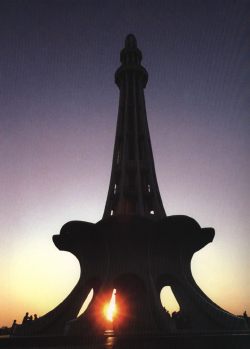
To mark this day the armed forces presents a parade which can be viewed by the public. The day always began with the 21 gun salute. The day still begins the same way but now people are fast asleep! The “salami” is a way of paying tribute to all the people who worked and died in trying to acquire this country for us. This is the day that we “actually” found our homeland. Had the idea not been floated at that time, we would not have had the identity that we have. To mark this very important day, the monument of Minar-e-Pakistan was constructed in 1968. This tall white tower stands in the middle of, then known as, Minto Park. A very fascinating fact about this construction is that, when you climb all those stairs (if you don’t have the energy, you can always take the lift), and get to the top, the view from above is beautiful. You get a bird’s eye view of Lahore. If you look down directly below, the base of the tower is shaped like a crescent and a star. The two very same symbols that are there on our national flag. We have forgotten how to be Pakistanis. We tend to forget about all those people who sacrificed their lives to give us this beautiful country, rich in all resources. It is time to recognise our duty to Pakistan as Pakistanis. This 23rd March, let’s all make a solemn promise that we will start showing respect for what we have and start to rebuild the image of Pakistan. Let’s start to work towards making this country into a peaceful nation where all religions, cast and creed can live in harmony.

The Idea of Pakistan  Pakistan: A Modern History  Long Live Pakistan

Thx bepakistan.com/the-pakistan-day-23rd-march/


Thursday, March 18, 2010

March 23, 1940: Lahore (Pakistan) Resolution (23March1940)


Adil Najam

March 23 commemorates the passage of what was originally the ‘Lahore Resolution’ (Qarardad i Lahore) and later became better known as the ‘Pakistan Resolution’ (Qarardad i Pakistan). If there is a single most important founding document of Pakistan, it has to be this Resolution passed at the annual session of the All India Muslim League at its 1940 meeting (22-24 March) at Minto Park (now called Iqbal Park), Lahore (by the way, what a wonderful idea - for political parties to have annual, open, meaningful, annual sessions where real decisions are taken in a transparent and democratic manner!). In 1941, this Lahore (Pakistan) Resolution became part of the Muslim League constitution and in 1946 it became the basis of the demand for Pakistan.
March 23,
 1940March 23,
 1940
March 23, 1940March 23,
 1940


 Most Pakistanis know what the resolution says; or, at least we think we do; in most cases rightly so. But because we are so very sure that we know what it says, we usually do not take the time to actually read it. Maybe we should. And there cannot be a better day to do so than today.
It is, like many of the most important documents in history, a fairly short text. I reproduce it here in full. The first two paragraphs are contextual related to the then discussions on federation within the Government of India Act 1935. The third and the fourth paragraphs are the key operational content which is usually cited in textbooks. However, my view is that the final short paragraph is also key; especially in that it talks in the plural about “respective regions” (as do previous paragraphs).
While approving and endorsing the action taken by the Council and the Working Committee of the All-India Muslim League, as indicated in their resolutions dated the 27th of August, 17th & 18th September and 22nd of October, 1939, and 3rd of February, 1940 on the constitutional issue, this Session of the All-India Muslim League emphatically reiterates that the scheme of federation embodied in the Government of India Act 1935, is totally unsuited to, and unworkable in the peculiar conditions of this country and is altogether unacceptable to Muslim India.
It further records its emphatic view that while the declaration dated the 18th of October, 1939 made by the Viceroy on behalf of His Majesty’s Government is reassuring in so far as it declares that the policy and plan on which the Government of India Act, 1935, is based will be reconsidered in consultation with various parties, interests and communities in India, Muslims in India will not be satisfied unless the whole constitutional plan is reconsidered de novo and that no revised plan would be acceptable to Muslims unless it is framed with their approval and consent.
Minar i PakistanResolved that it is the considered view of this Session of the All-India Muslim League that no constitutional plan would be workable in this country or acceptable to the Muslims unless it is designed on the following basic principles, viz., that geographically contiguous units’ are demarcated into regions which should be constituted, with such territorial readjustments as may be necessary that the areas in which the Muslims are numerically in a majority as in the North Western and Eastern Zones of (British) India should be grouped to constitute “independent States” in which the constituent units should be autonomous and sovereign.
That adequate, effective and mandatory safeguards should be specifically provided in the constitution for minorities in these units in the regions for the protection of their religious, cultural, economic, political, administrative and other rights and interests in consultations with them and in other parts of (British) India where the Mussalmans (Muslims) are in a majority adequate, effective and mandatory safeguards shall be specifically provided in constitution for them and other minorities for the protection of their religious, cultural, economic, political, administrative and other rights and interests in consultation with them.
This session further authorises the Working Committee to frame a scheme of constitution in accordance with these basic principles, providing for the assumption finally by the respective regions of all powers such as defense, external affairs, communications, customs and such other matters as may be necessary.
Pakistan 
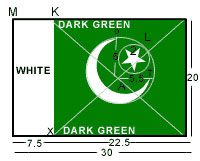
flag dimensionsApart from the fact that the Resolution talks clearly about “respective regions” (words that have import in the context of the events of 1971), I find the 4th paragraph particularly important. The complex structure of the language notwithstanding, the sentiment is clear as is its emphasis on the rights of minorities - not just of Muslims as a minority but of non-Muslim minorities in areas where they envisaged Muslim sovereignty. In such a short document, for the founding fathers to have devoted so much space to this issue would suggest that they - having lived as a minority themselves - considered the subject of minority rights to be of particular importance. This is one of the many areas where we were unable to live up to their aspirations.

Thx for pakistaniat.com/2007/03/22/march-23-1940-pakistan-day-resolution-lahore-qarardad-minto-park/comment-page-3/
Related Posts with 
Thumbnails


Wednesday, March 10, 2010

Speech of Quaid - e - Azam (23rd March 1940)


Muhammad Ali Jinnah, also known as Quaid-e-Azam in the history of India, is not only a great leader of Muslims of Indian sub-continent but he also holds an important position in the row of world politicians. The thing that distinguishes him from others leaders of the world is that he used Britains constitution to defeat Britains and won independence for his nation although he had to face stiff resistance from British government and great opposition from the Hindus' Indian National Congress. Muhammad Ali Jinnah was born in Karachi on 25th December 1876. His father's name was Poonja Jinnah, who was a merchant. He received his primary education from Sindh Mudrasatul-Islam in Karachi. After completing his primary education, he left for England, where he got admission in law and soon become a barrister. After completing his education, he came back to India and helped his father to overcome financial crises. Once Jinnah decided to give up his education but then he realized his mistake and started his education again. After coming back to India, he went to Bombay to start his practice. In the beginning, he faced some problems in getting cases but even at that time he refused to accept anyone's help and soon overcome this crisis. In the begging Jinnah was a great supporter of Hindu-Muslim unity, so, he joined All India National Congress. In 1913 Jinnah joined Muslim League and took an active part to make it effective. It was through his efforts that Muslim League and Congress Party agreed to a political settlement in 1916. This agreement is known as Lucknow Pact. According to this pact, Congress for the first time recognized a separate position of the Muslims and accepted the Muslim demand for a separate electorate. As the time passes and Jinnah realized that Congress is only for Hindus and only protecting Hindus rights, Jinnah left Congress and devoted all his energies for the welfare of Muslims of Indian Sub-Continent. In 1928, when Nehru put forward his report also known as Nehru Report in the history, in which he rejects the fact that Muslims are a separate nation in the India. In his report, he insisted that there is only one nation in the India i.e. Hindus (although Congress agreed in Lucknow Pact that Muslims are a separate nation). Jinnah put forward his fourteen points in 1929, in which it is clearly said that there are two big nations in the India i.e. Muslims and Hindus not one as it was claimed in Nehru report. Jinnah fourteen points also includes demands for some constitutional reforms. Jinnah was very anxious about the future of Muslims of India. He wished that the Muslims should emerge as an effective force but Muslim League suffered from internal problems. In 1934, Jinnah took over control of the Muslim League and made it strong and organized party within few years. In 1940, at the 27th annual session of the Muslim League, held in Lahore, Jinnah with other Muslim leaders analyzed the political problems of Muslims in great deal. A resolution was passed unanimously which is known as Lahore Resolution. In this resolution it was demanded that Muslims of the Indian Sub-Continent should have a separate homeland comprising the regions of the Sub-Continent having a Muslim majority. After the Lahore Resolution passed on 23rd March, 19940, the Muslim League entered into a new phase and under the presidency of Jinnah soon become a popular party. Jinnah put his best to made Muslim League a true representative party of Muslims. The results were obvious in 1945-46 elections, when Muslim League enjoyed a landslide victory both in central assembly as well as in provincial assembly elections. The Muslims continued their organized efforts under the guidelines provided to them by Jinnah. As a result of these efforts Pakistan came into being on 14th August, 1947.Jinnah was the first governor general of Pakistan. The establishment of Pakistan was the result of the constant struggle and great sacrifices of the Muslims of the Sub-Continent. It was due to determined and shrewd leadership of Jinnah that the Muslims of Sub-Continent had a homeland of their own. Jinnah passed away on 11th September 1948. He was given the title of Quaid-e-Azam (The greatest leader) by his nation for his services for his nation.


Monday, March 8, 2010

Women's Rights In Islam (8th March Woman Day)


The Conditions of Women in Arabia Before Islam
In those days before Islam, women were treated like slaves or property. Their personal consent concerning anything related to their well-being was considered unimportant, to such a degree that they were never even treated as a party to a marriage contract.

Women were used for one purpose, and then discarded. They had no independence, could own no property and were not allowed to inherit. In times of war, women were treated as part of the prize. Simply put, their condition was unspeakable.

In addition, the birth of a daughter in a family was not an occasion for rejoicing, but was regarded with humiliation. The practice of killing female children was uncontrolled.

With the advent of Islam came the verse from the Quran condemning those who practiced female infanticide:

"And when the news of (the birth of) a female (child) is brought to any of them, his face becomes dark, and he is filled with inward grief! He hides himself from the people because of the evil of that whereof he has been informed. Shall he keep her with dishonor or bury her in the earth? Certainly, evil is their decision."
(An-Nahl 16:58-59)

And as part of a description of various events on the Day of Judgment, the Quran mentions:

"And when the female (infant) buried alive (as the pagan Arabs used to do)
shall be questioned. For what sin she was killed? (At-Takwir 81:8-9)

Outside Arabia conditions for women were no better. In India, Egypt, and all European countries in the Dark Ages, women were treated worse than slaves. They were not regarded as human beings but as sort of a sub-species between humans and animals.
Allah (SWT) Gave the Arab Women Their Rights

The rights of Muslim women were given to us by Allah (SWT), who is All-Compassionate, All-Merciful, All-Just, All-Unbiased, All-Knowing and Most Wise. These rights, which were granted to women more than 1400 years ago, and were taught by the perfect example of the Prophet Muhammad (SAW), were given by the one Who created us and Who alone knows what rights are best for our female natures. Allah (SWT) says in the Quran:

"O You who believe! You are forbidden to inherit women against their will, and you should not treat them with harshness, that you may take away part of the Mahr (bridal-money given by the husband to his wife at time of marriage) you have given them, unless they commit open illegal sexual intercourse. And live with them honorably. If you dislike them, it may be that you dislike a thing and Allah brings
through it a great deal of good." (An-Nisa 4:19)

The most basic right of a woman in Islam is the knowledge and recognition that she never has to ask or demand or fight for her rights which are guaranteed to her by Allah (SWT) Himself.
Rights That Islam Gives to Women

Human Rights

Islam considers a woman to be equal to a man as a human being and as his partner in this life. Women have been created with a soul of the same nature as man’s. Allah (SWT) says in the Quran:

"O mankind! Be dutiful to your Lord, Who created you from a single person (Adam), and from him (Adam) He created his wife (Eve), and from them both He created many men and women and fear Allah through Whom you demand your mutual (rights), and (do not cut the relations of) the wombs (kinship). Surely, Allah is Ever and All-Watcher over you." (Al-Nisa 4:1)

And in the words of the Prophet Muhammad (SAW),

"Assuredly, women are the twin halves of men." (Sahih reported by Abu-Dawud (RA)

Islam does not blame Eve alone for the First Sin. The Quran makes it very clear that both Adam and Eve were tempted, that they both sinned and were both forgiven after their repentance. Allah (SWT) says in the Quran:

"Then Satan whispered suggestions to them both in order to uncover that which was hidden from them of their private parts (before); he said: "Your Lord did not forbid you this tree save you should become angels or become of the immortals." And he (Satan) swore by Allah to them both (saying): "Verily, I am one of the sincere well-wishers for you both." So he mislead them with deception. Then when they tasted of the tree, that which was hidden from them of their shame (private parts) became manifest to them and they began to stick together the leaves of Paradise over themselves (in order to cover their shame). And their Lord called out to them (saying): "Did I not forbid you that tree and tell you: Verily, Satan is an open enemy unto you?" They said: "Our Lord! We have wronged ourselves. If You forgive us not, and bestow not upon us Your Mercy, we shall certainly be of the losers." (Allah) said: "Get down, one of you an enemy to the other (i.e. Adam, Eve, and Satan, etc.). On earth will be a dwelling-place for you and an enjoyment, - for a time." He said: "Therein you shall live, and therein you shall die, and from it you shall be brought out (i.e. resurrected)."(Al-A’raf 7:20-25)

In Islamic law a woman is an independent, unique individual in her own right. She has the same responsibilities towards herself, towards Allah (SWT) and towards other human beings as the male, and will be punished or rewarded in the Hereafter without discrimination towards her female gender.

Civil Rights

There is no compulsion in religion according to the Quran:

"There is no compulsion in religion. Verily, the Right Path has become distinct from the wrong path. Whoever disbelieves in Taghut [anything worshipped other then the Real God (Allah)] and believes in Allah, then he has grasped the most trustworthy handhold that will never break. And Allah is All-Hearer, All-Knower."
(Al-Baqarah 2:256)

A Muslim woman is not permitted to change her family name to her husband’s name upon marriage. She is always known by her father’s name, as a mark of her own identity. In choosing a marriage partner, her consent to accept or reject any prospective suitor for marriage must be respected. A Muslim woman has the right to seek divorce, if necessary within the laws of Islam.
Muslim Women Have the Right to Go Outside of Her Home

Muslim women are not forbidden from going out in the community, working, or visiting relatives and female friends, if there is no objection from their guardian/husband and they are covered and behave and speak according to Islamic guidelines and, if necessary, escorted by their Mahram (a close male relative). However, a woman’s home should be the main base that she works from. Allah (SWT) instructed the wife’s of the Prophet (SAW):
"O wives of the Prophet! You are not like any other women. If you keep your duty (to Allah), then be not soft in speech, lest he is whose heart is a disease (of hypocrisy or evil desire for adultery, etc.) should be moved with desire, but speak in an honorable manner. And stay in your houses, and do not display yourselves like that of the times of ignorance, and offer prayers perfectly (Iqamat-as-Salat), and give Zakat and obey Allah and His Messenger. Allah wishes only to remove Ar-Rijs (evil deeds and sins, etc.) from you, O members of the family [of the Prophet (SAW)], and to purify you with a thorough purification." (Al-Ahzab 33:32-33)
A Woman in Islam Has the Right to Get an Education

In the words of the Prophet Muhammad (SAW):

"To seek knowledge is obligatory on every Muslim."
(Declared Authentic By Shaikh Muhammad Naasir-ud-Deen Al-Albaani)

Muslim here meaning male and female Muslims, as women are the twin halves of men. The Prophet (SAW) also said:

"Whoever follows a way to seek knowledge, Allah will make easy for him a way to paradise." (Declared Authentic By Shaikh Muhammad Naasir-ud-Deen Al-Albaani)

A woman in Islam has the right to knowledge and education. Allah (SWT) encourages women to read and keep up the learning process. He also bestows His mercy upon all who seek knowledge, and gives them high status:

"Is one who is obedient to Allah, prostrating himself or standing (in prayer) during the hours of the night, fearing the Hereafter and hoping for the Mercy of his Lord (like one who disbelieves)? Say: "Are those who know equal to those who know not?" It is only men of understanding who will remember (i.e. get a lesson from Allah’s Signs and Verses). (Az-Zumar 39:9)

"O you who believe! When you are told to make room in the assemblies, (spread out and) make room. Allah will give you (ample) room (from His Mercy). And when you are told to rise up (for prayers, Jihad, or for any other good deed), rise up. Allah will exalt in degree those of you who believe, and those who have been granted knowledge. And Allah is Well-Acquainted with what you do. (Al-Mujadilah 58:11)

This is referring to religious knowledge, in the first place, and to any other kind of knowledge, in the second place, where one has the intention of benefiting herself, her family and the Islamic society. Additionally, a husband should not forbid his wife from going out of the house to seek basic religious knowledge, unless he is teaching her at home. The Quran advises mankind to pray:
"Then High above all be Allah, the True King. And be not in haste [O Muhammad (SAW)] with the Quran before its revelation is completed to you, and say: My Lord! Increase me in knowledge." (Ta-Ha 20:114)
The Right to Go to the Mosque

The Messenger of Allah (SAW) said:

"If someone’s wife asks his permission to go to the mosque, he should not deny it to her."

Women should be covered Islamically, according to the Muslim woman's dress requirements (see Her Dress).

At the same time, a woman’s prayer in her home is better, from the standpoint of her household duties and duties as a mother. Also it is better in the sense that it prevents unnecessary mixing with men. The Prophet (SAW) also stated on another occasion:
"But their homes are better for them." (Reported by Abu Dawud and Ahmed)
Islam Gives Men and Women Equal Rights

In reality, and in Islam, the rights and responsibilities of a woman are equal to those of man, but they are not necessarily identical with them. Equality and sameness are two very different things. I think you’ll agree that, for one thing, women and men are physically very different from one another, although they are equal to each other in other important ways.

In the West, women may be doing the same job that men do, but their wages are often less. The rights of Western women in modern times were not created voluntarily, or out of kindness to the female. The modern Western woman reached her present position by force, and not through natural processes or mutual consent of Divine teachings. She had to force her way, and various circumstances aided her. Shortage of manpower during wars, pressure of economic needs and requirement of industry forced women to leave their homes to work, struggling for their livelihood, to appear equal to men. Whether all women are sincerely pleased with these circumstances, and whether they are happy and satisfied with the results, is a different matter. But the fact remains that whatever rights modern Western women have, they fall short of those of her Muslim counterpart! Islam has given woman what duties her female nature. It gives her full security and protects her against becoming what Western modern women themselves complain against: a "mere sex object."
The Right to Seek Employment

If you take a look at many societies today, a woman is only valued and considered important if she performs the functions of a man, (while at the same time displaying her feminine attractions to the public). While these women may carry the immense responsibility of bearing and rearing children, you have to admit that they may still be at par with men in nearly every area of life. The result is the present-day confusion concerning sex role differentiation, resulting in very large numbers of divorces and emotionally distraught children.

In Islam, however, the value and importance of women in society and the true measure of their success as human beings, is measured with completely different criteria: their fear of Allah (SWT) and obedience to Him, and fulfillment of the duties He has entrusted them with, particularly that of bearing, rearing and teaching children.

Nevertheless, Islam is a practical religion, and responds to human needs and life situations. Many women need, or wish, to work for various reasons. For example, they may possess a needed skill, such as a teacher or a doctor.

While Islam does not prohibit women working outside the home, it does stipulate that the following restrictions be followed to safeguard the dignity and honor of women and the purity and stability of the Islamic society, (the conduct of women, after all, is the "backbone" of any society):

1. Outside employment should not come before, or seriously interfere with her responsibilities as wife and mother.

2. Her work should not be a source of friction within the family, and the husband’s consent is required in order to eliminate later disagreements. If she is not married, she must have her guardian’s consent.

3. Her appearance, manner and tone of speech and overall behavior should follow Islamic guidelines. These include: restraining her glances in relation to any men near the work place, wearing correct Islamic dress, avoiding men, not walking in a provocative manner, and not using make-up or perfume in public.

4. Her job should not be one which causes moral corruption in society, or involve any prohibited trade or activity, affect her own religion, morals, dignity and good behavior, or subject her to temptations.

5. Her job should not be one which is mixing and associating with men.

6. A woman should try to seek employment in positions which require a woman’s special skills, or which relate to the needs of women and children, such as teaching, nursing other women, midwifery, medicine with specialization’s like pediatric or obstetrics-gynecology.
A Muslim Woman is Required to Dress a Certain Way When She Goes Out in Public

For a Muslim woman, her modest dress is an expression of a universal sisterhood. An Islamic dress also liberates the Muslim woman, and she is then automatically respected for her mind instead of her body. Simply put, she retains her dignity! It is like saying: I am a respectful woman. I am not for every man to look at, touch, or speak to. I am protected, exactly like a precious white pearl which, if touched by everyone, will become black and dirty.

A woman’s modest dress protects society from adultery and other forms of illegal sexual relations that lead to the break up of families and corruption of society.

Thank You. realislam.com/muslim_women.htm